
In March, we wrote that the EU customs reform was under way. It has now been adopted. The Council gave its final green light on 3 September 2026, the European Parliament followed, and the new Union Customs Code entered into force on 20 September 2026.
Described as the biggest reform since the customs union was created in 1968, it will apply in stages until 2034. That distant horizon is reassuring. It should not be.
Because while the reform settles in, other deadlines are falling due, much sooner. None of them comes as a surprise. All of them are prepared the same way: before the goods leave.
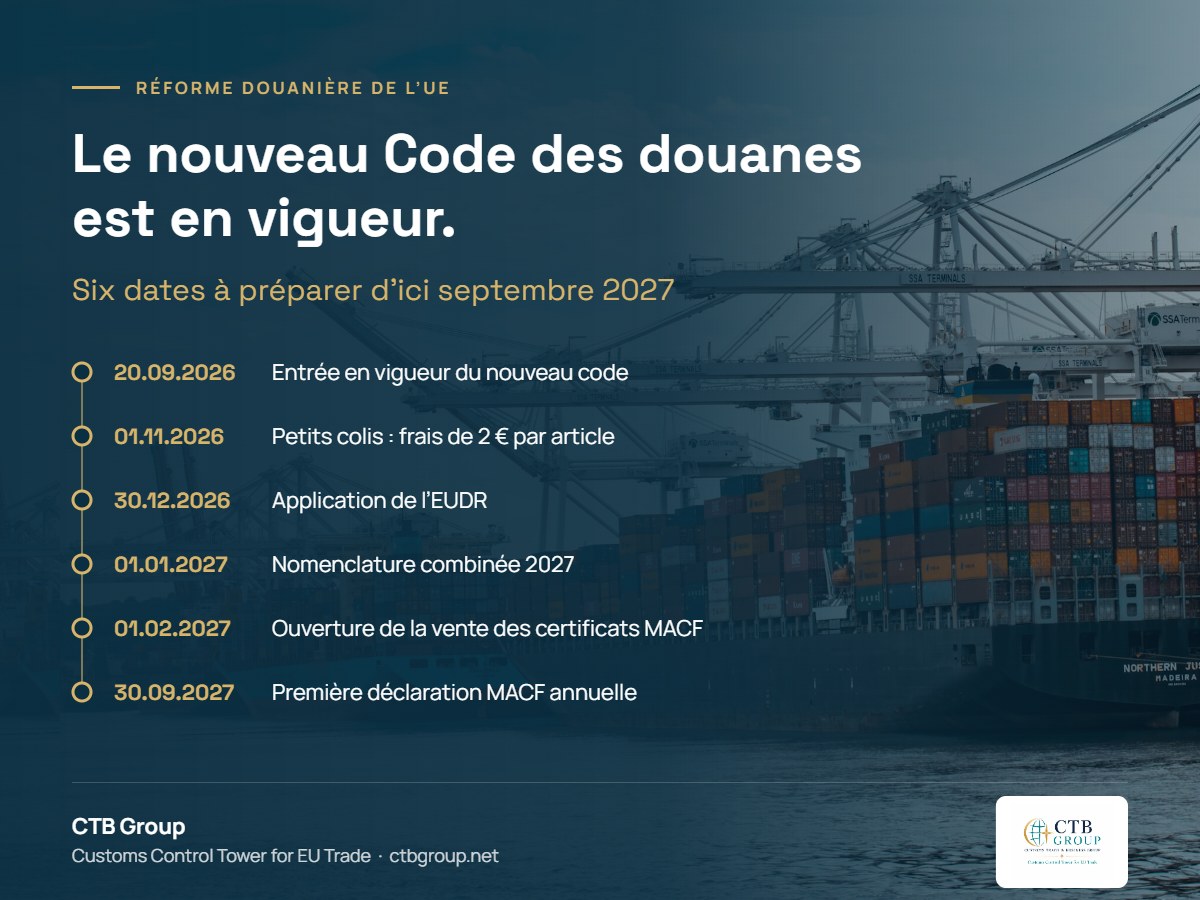
1. 20 September 2026: the reform is in force
Three changes shape the new code:
- A single entry point. The future EU Customs Data Hub will let traders submit data once, instead of twenty-seven times. It becomes mandatory for e-commerce on 1 July 2028, and for all operators on 1 March 2034.
- A European customs authority. Based in Lille, it starts operating in 2027. Its task: to analyse data and target risky consignments at EU level.
- A “Trust and Check” status. The most transparent operators will be able to release their goods for free circulation without active customs intervention.
This last point deserves attention now. Trust cannot be declared: it has to be demonstrated, file after file. Companies that already document their classifications, values and origins properly will start with a head start.
2. 1 November 2026: fees on small parcels
Since 1 July 2026, low-value consignments bought online have been subject to a flat customs duty of 3 euros. The reform adds a handling fee, applicable no later than 1 November 2026. On 21 September, the Commission set it at 2 euros per item, through a delegated act still subject to objection by the Parliament and the Council.
Do you sell online into the EU, or bring in samples by parcel? Check now who bears these fees, and how they show up in your prices.
3. 30 December 2026: the EUDR applies
The EU Deforestation Regulation applies to large and medium-sized companies on 30 December 2026, and to micro and small enterprises on 30 June 2027. The review published by the Commission in May confirmed these dates.
Coffee, cocoa, soy, wood, palm oil, rubber, cattle: without a due diligence statement linked to the customs declaration, the goods can stay on the quay, even if they are environmentally impeccable. We explained this in detail in our article of 16 September.
4. 1 January 2027: the 2027 Combined Nomenclature applies
As every year, the Commission publishes in the autumn the version of the Combined Nomenclature that applies from the following 1 January. An eight-digit code that disappears or is split, and a duty rate, an anti-dumping measure or a licence changes with it.
The useful reflex: as soon as it is published, compare your most-used codes with the new version, then update your item records and your software before the first imports in January.
5. 1 February 2027: CBAM certificates go on sale
The Carbon Border Adjustment Mechanism (CBAM) has been in its definitive phase since January 2026. From 1 February 2027, authorised declarants will be able to buy their certificates on the Commission's central platform.
From 2027, at the end of each quarter, they must hold certificates covering at least 50% of the embedded emissions in their imports of the year. For steel, aluminium, fertilisers or cement, this is a cash-flow line to plan for in the 2027 budget.
6. 30 September 2027: the first CBAM declaration
This is the deadline to submit the first annual declaration, covering 2026 imports, and to surrender the corresponding certificates. Your suppliers' emissions data must therefore be collected now, not in August 2027.
What these dates have in common
Each of these deadlines is played out upstream. A code checked in November costs a few hours; the same code corrected after an audit costs a reassessment, delays and sometimes a customer. The reform reinforces this logic: the EU now relies on reliable data, submitted once and checked through risk analysis.
That is exactly what we do. We act as a customs control tower: we check the classification, origin, value and regulatory obligations of your goods, then prepare a ready-to-file dossier.
CTB Group manages customs compliance and governance; the declarations themselves remain filed by the representatives appointed by the company.
Which date comes first for you?
If one of these six dates concerns your flows, let's talk before it arrives. The first conversation (30 minutes) is free: it is often enough to identify the two or three points to secure first.
Write to us at contact@ctbgroup.net or call +32 456 90 15 78. Multilingual service.
First conversation free (30 min)
Vanessa Cavalcante Vieira, founder of CTB Group
Further reading
- EU customs reform: what lies ahead until 2028
- CBAM 2026: what changes for European importers
- “Ready-to-Import” customs diagnostic
Sources: Council of the EU, press releases of 26 March and 3 September 2026; European Commission, EUDR review of 4 May 2026, delegated act of 21 September 2026 and CBAM rules. Article up to date as of 30 September 2026. Photo: Andy Li / Unsplash.